Best Hybrid Solar System Guide for Pakistan | SunnyPath Energy
What is a Hybrid Solar System — And Why It’s the Smartest Choice in Pakistan Right Now
Load shedding is not going anywhere. Electricity bills are going up every few months. And if you’re still running on grid power alone in Karachi, you already know the pain.
Solar is the answer — but not just any solar setup. If you’re serious about saving money, having backup power, and future-proofing your home or business, a hybrid solar system is the only option worth considering right now.
Here’s everything you need to know — explained the way we explain it to our own clients at SunnyPath Energy.
What Exactly is a Hybrid Solar System?
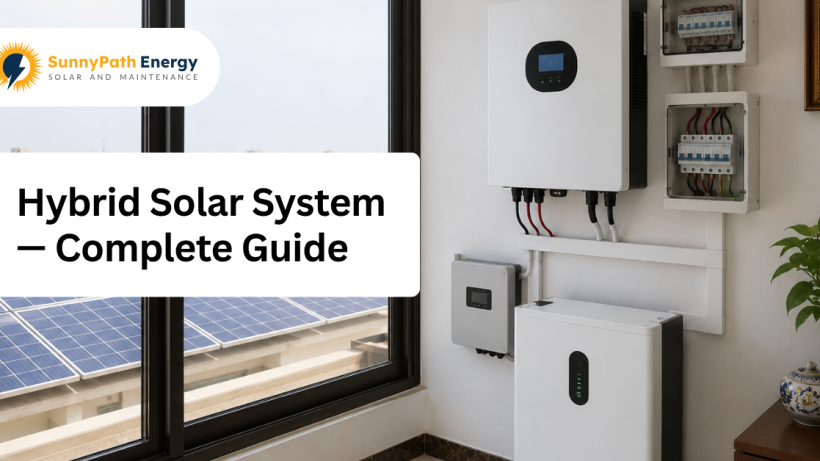
A hybrid solar system combines solar panels, a hybrid inverter, and a battery bank — all working together. During the day your panels generate electricity. That power runs your home, charges your battery, and if you have net metering, sends excess units back to the K-Electric grid. At night or during load shedding, your battery kicks in and keeps your home running.
It’s the best of all three worlds — solar generation, battery backup, and grid connectivity.
Compare that to:
On-grid system — generates solar power and feeds it to the grid. No battery. No backup. When K-Electric goes down, your system shuts off too. You’re left in the dark.
Off-grid system — fully battery dependent, no grid connection. Works in remote areas but expensive to maintain and not practical for Karachi residential use.
Hybrid system — generates power, stores it in battery, stays connected to the grid, and gives you net metering eligibility. This is what we recommend for almost every client in Karachi.
Single Phase vs Three Phase — Which Hybrid Inverter is Right for You?
This is where most people get confused. The answer depends entirely on your K-Electric meter.
Single Phase Hybrid Inverters
If you have a single phase meter at home, you need a single phase hybrid inverter. Our top choices for single phase residential setups are Inverex and Ziewnic — both excellent options in the IP65 category, meaning they’re dust and water resistant. Built for Pakistan’s climate and K-Electric conditions. Reliable, well-supported, and proven performers.
For single phase we always recommend pairing your hybrid inverter with a lithium-ion battery rather than tubular batteries. Here’s the math that makes it obvious:
A set of 4 tubular batteries costs around Rs. 250,000. Their lifespan? 2 to 3 years. So every 2 to 3 years you’re spending Rs. 250,000 again.
A 5KWh lithium-ion battery costs around Rs. 270,000. Its lifespan is 10 years and it comes with a 5-year replacement warranty.
Over 10 years you’d spend Rs. 1,000,000 to 1,250,000 replacing tubular batteries. You’d spend Rs. 270,000 once on lithium. The choice is obvious.
Three Phase Hybrid Inverters
If you have a three phase K-Electric meter — which most commercial setups and larger homes have — go hybrid without question. Don’t even consider on-grid.
Our top recommendations for three phase hybrid systems:
Solis 12KW Hybrid — solid performer, reliable for commercial and large residential Inverex Nitrox — proven in Pakistan market, strong after-sale support Ziewnic Three Phase Hybrid — excellent build quality, IP65 rated
System Sizes — What’s Right for Your Consumption?
Single phase residential systems typically range from 5KW to 15KW. Three phase goes from 12KW to 15KW for standard residential use.
For homes with higher consumption — or those who want maximum output and backup — high voltage hybrid systems from 20KW, 30KW, and 50KW are also installed residentially. These same high voltage systems cover commercial setups, schools, hospitals, and industrial units as well. Every system is sized based on your actual load and requirements.
Why Three Phase Users Must Go Hybrid — Not On-Grid
This is the advice we give every three phase client and it’s the most important thing in this blog.
If you install an on-grid system on a three phase meter, you are limiting yourself from day one.
Let’s say your system generates 50 to 60 units per day. Your home consumes 30 units and your battery needs 5 units to charge. That leaves 15 to 25 units generated but unused — completely wasted if you’re on-grid without net metering.
With a hybrid system you can apply for net metering — also called net billing — through K-Electric. Those excess units get fed back into the grid and credited to your monthly bill. If you’re sending back 15 units a day, that’s 450 units a month credited to your account. After bill adjustment your electricity bill drops dramatically — sometimes to near zero.
Why would you waste 15 units a day when you can sell them back?
The Hybrid + Net Metering Combination is the Real Game Changer
Here’s the full picture of what a properly installed hybrid system with net metering does for you:
- Daytime — panels run your load directly, zero units consumed from K-Electric
- Battery charging — excess generation charges your battery throughout the day
- Peak hours and night — battery powers your home, no grid consumption
- Excess units — fed to K-Electric grid, credited to your monthly bill
- Load shedding — battery backup keeps you running, system doesn’t shut off
This is not a want anymore. With electricity bills in Karachi reaching Rs. 50,000 to Rs. 100,000 per month for larger homes and businesses, solar with hybrid and net metering is a financial necessity.
What SunnyPath Energy Recommends
After installing systems across Karachi — residential, commercial, hospitals, schools, and industrial setups — here’s our straightforward advice:
Single phase meter at home? Go with a single phase hybrid inverter — Inverex or Ziewnic — paired with a 5KWh lithium-ion battery. Skip the tubular batteries entirely.
Three phase meter? Go hybrid — Solis, Inverex Nitrox, or Ziewnic three phase. Apply for net metering immediately after installation. Don’t waste a single generated unit.
Higher consumption or want maximum output? Look at high voltage hybrid systems — 20KW, 30KW, or 50KW — sized to your actual load.
Already have an on-grid system? You can upgrade. We replace on-grid inverters with hybrid inverters and add battery storage. Your existing panels stay as-is in most cases.
Ready to Switch to Hybrid?
SunnyPath Energy installs, upgrades, and maintains hybrid solar systems across Karachi. We handle everything — system design, installation, commissioning, net metering application, and ongoing monitoring.
📞 Call us: 0306-2948694 | 0344-7654540
📧 Email: hello@sunnypathenergy.com
📍 48c Lane Number 15, Bukhari Commercial Area, Phase 6, DHA, Karachi
Frequently Asked Questions
Q: What is the difference between hybrid and on-grid solar systems? An on-grid system has no battery and shuts off during load shedding. A hybrid system has battery backup, stays running during outages, and gives you net metering eligibility.
Q: Which hybrid inverter is best for home use in Karachi? For single phase residential setups we recommend Inverex and Ziewnic. For three phase we recommend Solis, Inverex Nitrox, and Ziewnic three phase hybrid inverters.
Q: Is lithium battery better than tubular battery for solar in Pakistan? Yes. A lithium-ion battery costs slightly more upfront but lasts 10 years with a 5-year replacement warranty. Tubular batteries need replacing every 2 to 3 years and end up costing significantly more over time.
Q: Can I get net metering with a hybrid solar system in Karachi? Yes. Hybrid systems are eligible for K-Electric net metering — also called net billing. SunnyPath Energy handles the complete net metering application and process.
Q: Can I upgrade my existing on-grid system to hybrid? Yes. We replace your existing on-grid inverter with a hybrid inverter and add a battery bank. Your panels and wiring stay as-is in most cases.
Q: What sizes do hybrid solar systems come in? Single phase residential systems range from 5KW to 15KW. Three phase goes from 12KW to 15KW for standard residential use. High voltage hybrid systems from 20KW to 50KW and above are available for larger homes with higher consumption and for commercial, industrial, and institutional setups.
Q: Is solar worth it in Karachi right now? Absolutely. Load shedding is a daily reality and electricity tariffs keep rising. A hybrid solar system with net metering is no longer a luxury — for most homes and businesses in Karachi it’s the most practical financial decision you can make right now.
