
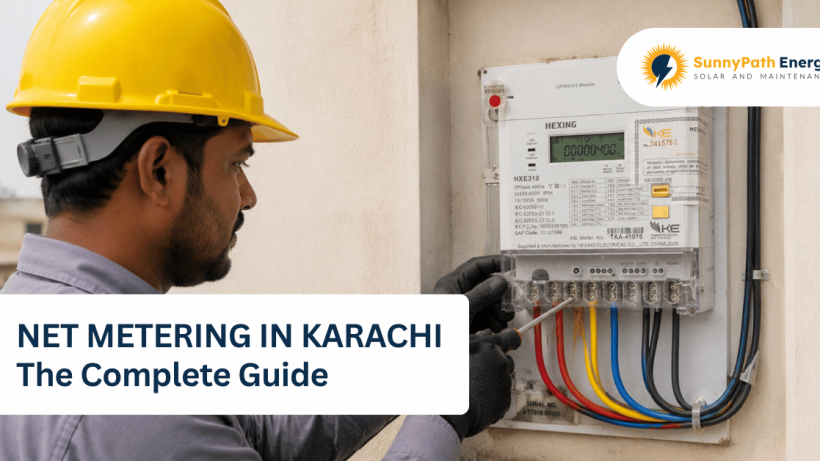
Net Metering in Karachi — Complete 6-Step Guide | SunnyPath Energy
Net Metering in Karachi — The Complete Guide (What K-Electric Actually Requires)
Everyone talks about net metering. Very few people explain what it actually takes to get it done — and why so many applications get delayed or rejected before the reverse meter ever gets installed.
This guide is based on what we do at SunnyPath Energy, handling net metering applications in Karachi from start to finish. No generic information — just the real process, real requirements, and real mistakes that cost people months of waiting.
What is Net Metering and Why Does It Matter?
Net metering — also called net billing — is a K-Electric approved system that allows your solar setup to feed excess generated electricity back into the grid. K-Electric credits those units against your monthly consumption bill. If your system generates more than you use in a month, those extra units carry forward as credit.
The math is simple. A 12KW hybrid system in Karachi can generate 50 to 60 units per day. If your household or office consumes 30 units and your battery charges with 5, that’s 15 to 25 units going to waste every single day without net metering. Over a month that’s 450 to 750 units — credited to your bill if you’re net metered, completely wasted if you’re not.
This is why we tell every three-phase client: net metering is not optional, it’s the part that makes the investment actually pay off.
Before You Apply for Net Metering in Karachi — Are You Actually Eligible?
This is where most people go wrong before the process even starts.
You must have a three-phase K-Electric meter. Net metering is not available on single-phase connections. If you have a single-phase meter and want net metering, you’d first need to upgrade your connection to three-phase — a separate process with K-Electric entirely.
Your solar system must also be three-phase. Single-phase hybrid inverters are not eligible regardless of capacity.
Your sanctioned load must match or exceed your solar system capacity. This is the most commonly misunderstood requirement — and the most common reason applications get rejected.
Here’s what this means practically: if you have a 10KW hybrid system installed and you’re applying for net metering, your sanctioned load on your K-Electric bill needs to be at minimum 10KW. We always recommend 12 to 13KW of sanctioned load as a buffer — because if you’re installing 20 panels at 585W each, that’s around 11,700W of actual panel capacity, so your sanctioned load should cover that comfortably.
The rule of thumb we follow: sanctioned load should be 2 to 3KW above your installed solar capacity. This small buffer prevents rejection at the first stage of the net metering in Karachi application.
If your sanctioned load is lower than your system — say you have 6KW sanctioned load and you installed a 12KW system — your application will be delayed or rejected. You’d need to get your sanctioned load increased first, which adds weeks to the timeline.
Documents Required for Net Metering Application
The documentation process is straightforward if your paperwork is in order:
CNIC — your national identity card K-Electric electricity bill — must be in your own name, and the CNIC number on the bill must match your CNIC Property lease agreement — only required if the bill is not in your name. If the bill is already in your name, this is not mandatory.
That’s it on the documentation side. The technical side is where most applications run into trouble.
Technical Requirements — What K-Electric Checks on Survey
K-Electric sends a survey team to physically inspect your system before approving net metering in karachi. This is where installations done incorrectly get caught — and where the clock stops if something needs fixing.
The grid cutoff test — hybrid vs on-grid systems
When the survey team visits, they physically cut off the grid supply and turn off the main breaker. What happens next depends on your system:
If you have a hybrid system — the system must immediately go on alarm (red light or fault indicator) confirming the grid is disconnected, and simultaneously switch over to battery or solar power. Your load continues running on backup. This is the correct behavior and exactly what K-Electric wants to see.
If you have an on-grid system — the system must go on alarm and your total load cuts off completely. No electricity at all. This is correct for on-grid since there’s no battery — the alarm confirms the system properly detected grid failure and shut down rather than continuing to draw or feed power unsafely.
In both cases the alarm triggering correctly is mandatory. If the system does NOT alarm after the grid is cut — meaning it’s still detecting or drawing AC from somewhere even with the breaker off — that’s an automatic survey rejection. It means there’s an unintended AC connection path in the wiring somewhere, which is both a safety hazard and a compliance failure. The installation needs to be fully inspected and corrected before the survey can be rescheduled.
AC and DC must be completely separated
Your AC distribution — home wiring, mains, loads — must be entirely separate from your DC side (panels, battery, inverter DC connections). Any cross-interference between AC and DC paths is a compliance failure.
Earthing must be correct, separate, and high quality
As per K-Electric guidelines, you need a minimum of two earthings — one dedicated to the AC side and one dedicated to the DC side. A single combined earthing is not compliant and will fail the survey.
But having two earthings isn’t enough on its own — the earthing resistance value must be below 5 Ohms. This is the specific threshold K-Electric tests on survey day, and this is where a large number of surveys get cancelled. The team arrives, tests the earthing resistance, reads a value above 5 Ohms, and the entire survey is stopped right there. Application stalled, rescheduling required, timeline extended by weeks.
Why does the value go above 5 Ohms by survey time? Almost always because of low quality earthing material. Many installers use local vendor materials — silver-coated or mixed-metal rods instead of solid copper. When the earthing is freshly done the resistance reads fine. But over weeks and months as the material degrades in the ground, the resistance value climbs. By the time K-Electric arrives for the survey, it’s already above the threshold.
At SunnyPath Energy we use full copper earthing material exclusively. Yes it costs slightly more than the local alternatives — but it maintains its resistance value over time and stays well within the 5 Ohm threshold. We’d rather spend the extra on material than have a client’s survey fail and add months to their net metering timeline.
And earthing isn’t just a net metering requirement — it’s a genuine safety component for your entire system. Proper earthing protects against surge current from lightning or grid voltage spikes. It also protects you physically — if you’re washing your solar panels on the roof and your earthing is poor quality or missing, a fault in the system could pass current through the water to you. Low quality earthing on a rooftop solar system isn’t just a compliance issue. It’s a safety hazard.
Surge protection (SPD/arrestors) must be correctly installed
If you have a DC arrestor — surge protection device on the DC cable from panels — it must have its own separate earthing fitting. It cannot share the same earthing path as other DC components. This is a technical detail many installers miss and K-Electric specifically checks for.
The Net Metering In Karachi Process — Step by Step
Step 1 — Pre-application compliance check Before anything is submitted, verify sanctioned load vs system capacity, confirm three-phase meter and three-phase inverter, and check all technical compliance points. Fixing these after submission causes delays.
Step 2 — Documentation preparation Gather CNIC and K-Electric bill — same name, same CNIC number. Property lease only if bill is not in your name.
Step 3 — Application submission to K-Electric and NEPRA The application goes to both K-Electric and NEPRA. NEPRA processing fees are paid directly by the client — this is not part of installation cost and varies based on system capacity.
Step 4 — K-Electric technical survey K-Electric schedules a site visit to inspect the system. The system must pass on the first visit. If anything fails, the survey needs to be rescheduled and the timeline extends significantly.
Step 5 — Approval and reverse meter installation Once the survey passes, K-Electric processes the approval and schedules installation of the reverse/bidirectional meter.
Step 6 — System goes live on net metering From this point your excess generation starts being credited to your bill every month.
Realistic Timeline — How Long Does This Take?
Based on our experience handling net metering applications in Karachi: 1.5 to 2 months from application submission to working reverse meter — assuming the system passes survey on the first visit and documentation is complete from day one.
Two things that extend this timeline:
Failed survey visit — system alarm failure, incorrect earthing values above 5 Ohms, wrong SPD installation, or AC/DC separation issues. This adds 3 to 4 weeks minimum while corrections are made and a new survey is scheduled.
Sanctioned load mismatch — if your sanctioned load is below your system capacity and wasn’t caught before submission, the application gets rejected. Getting sanctioned load increased is a separate process that can add months before you can reapply.
At SunnyPath Energy we do a full technical compliance check before submitting any application — specifically to avoid these delays. The 1.5 to 2 month timeline is achievable when the groundwork is done correctly from the start.
What SunnyPath Energy Handles for You
The net metering in karachi process involves technical compliance, documentation, and coordination across K-Electric and NEPRA simultaneously. We manage the entire process:
- Pre-application technical compliance check and rectification if needed
- Documentation preparation and application submission
- Coordination with K-Electric for survey scheduling
- Our representative is present on-site during the K-Electric survey
- Follow-up until reverse meter is installed and system is live on net metering
Any K-Electric or NEPRA charges are payable directly by the client — we communicate all applicable government fees in advance so there are no surprises.
📞 Call us: 0306-2948694 | 0344-7654540
📧 Email: hello@sunnypathenergy.com
📍 48c Lane Number 15, Bukhari Commercial Area, Phase 6, DHA, Karachi
Frequently Asked Questions
Q: Can I get net metering with a single-phase solar system in Karachi? No. Net metering with K-Electric requires a three-phase meter and a three-phase solar system. Single-phase connections are not eligible.
Q: What sanctioned load do I need for net metering? Your sanctioned load should be 2 to 3KW above your installed solar system capacity. For a 12KW system, we recommend 13 to 14KW sanctioned load to avoid rejection.
Q: My bill is not in my name — can I still apply? Yes but you’ll need a property lease agreement along with the bill and CNIC. It’s simpler if the bill is already in your name.
Q: Why did my net metering application get rejected? The two most common reasons are sanctioned load being lower than system capacity, and technical failures during the K-Electric survey — usually the alarm not triggering correctly on grid cutoff, earthing resistance above 5 Ohms, or AC/DC separation issues.
Q: How long does net metering take in Karachi? Typically 1.5 to 2 months from application to working reverse meter — provided the system passes the K-Electric survey on the first visit and all documentation is correct from day one.
Q: What is the earthing resistance requirement for net metering in karachi? K-Electric requires earthing resistance to be below 5 Ohms. This is physically tested on survey day. Poor quality earthing material causes resistance values to climb over time and fail this test — which is why we use full copper earthing exclusively.
Q: What happens during the K-Electric survey? The survey team physically inspects your system, tests earthing values (must be below 5 Ohms), checks AC/DC separation, verifies SPD installation, and cuts the grid supply to confirm your system responds correctly — alarm triggering and either switching to battery/solar (hybrid) or shutting down completely (on-grid). Our representative is present on-site during this visit.
Q: Does SunnyPath Energy handle the full net metering process? Yes. We manage everything from pre-application compliance check to coordinating the K-Electric survey and following up until your reverse meter is installed. Government charges payable to K-Electric and NEPRA are communicated in advance and paid directly by the client.
